Attention and habitsGuide
Brainrot by age: what to watch for in young children, schoolchildren and teenagers
We choose content for young children and gradually teach older ones independence. An overview by age: what research shows and which boundaries I recommend setting before difficulties arise.

Published · 13 min read · Updated
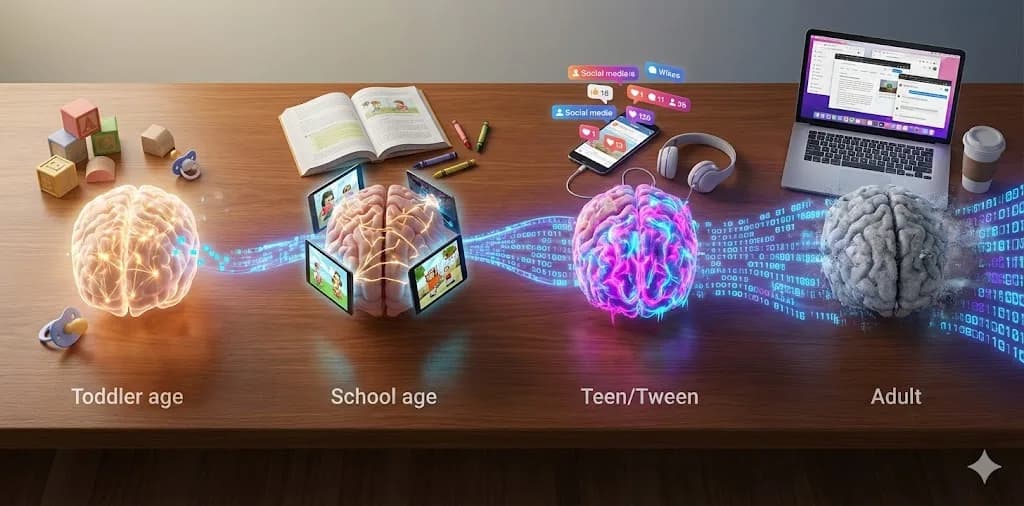
We might say ‘Put that phone away’ to a preschooler, a child in year six of a Czech school or a student about to take their school-leaving exams. But our role is different each time. For a young child, we choose almost their entire environment. A teenager should have increasing room to make decisions and understand their own reasons for changing something. That does not mean all boundaries disappear with age. I recommend protecting time for sleep, study and shared activities in every group, before we begin addressing specific difficulties.
The age boundaries in this overview are approximate. A child's development does not follow a table, and the research below examines different activities: screens generally, social media and using a phone in bed. Brainrot is an umbrella colloquial expression, not a single shared illness.
A quick overview
| Age | What to pay attention to | Recommended first step |
|---|---|---|
| 0–5 years | Space for speech, play, movement and contact with an adult. | Do not give free access to the feed; an adult chooses the content and when viewing ends. |
| 6–10 years | Finishing tasks and developing everyday habits. | Choose specific content, determine an ending and keep the feed away from study. |
| 11–13 years | Sleep, the need to be among peers and growing independence. | Introduce a phone-free night-time routine and separate contact with friends from scrolling. |
| 14–17 years | The ability to manage their own time and the effects on life. | Extend independence while keeping agreed boundaries; evaluate their own goals. |
| Adults | Our own availability, concentration and the rules we follow ourselves. | Try the same change we ask of the child. |
The first steps in the table are our editorial recommendations.
0–5 years: how much of the world fits into a day
A young child needs to touch things, try things with them and watch how another person responds. This includes responses to babbling and playing together. Harvard's Center on the Developing Child states that more than a million new neural connections form every second in the first few years; experiences, including repeated interaction with a caring adult, play an important part in development. 1 That is why, with the youngest children, I am interested in the whole day: how much space remains for speech, movement and trying things for themselves.
In a Japanese study of 7 097 mother–child pairs, researchers compared screen time at age one with later development. At age two, they assessed communication skills among other things. The table shows the proportion of children whose score on the communication section of the questionnaire fell below the threshold suggesting developmental delay: 2
| Screen time at age one | Proportion below the specified communication threshold at age two |
|---|---|
| Less than 1 hour a day | 3.5 % |
| 1 to less than 2 hours | 5.3 % |
| 2 to less than 4 hours | 6.8 % |
| 4 hours or more | 14.8 % |
The difference between groups is a reason to take several hours of daily viewing by a one-year-old seriously. The figures describe the proportion of children below a specified threshold, not the degree of brain damage. The study also examined screens generally, rather than short videos alone, and did not randomly allocate use to families. It therefore cannot establish causation on its own. A questionnaire result is a prompt for further assessment, not a diagnosis of an individual child.
How to approach screens
I would not give young children free access to a personalised feed at all. An adult should choose both the content and when viewing ends. When you put on a cartoon, select it and watch together where possible. You can pause at a familiar animal, follow it with a rhyme or later act out something from the story. WHO recommends no more than an hour a day of sedentary screen time for children aged two to four, with less being better. It does not recommend such viewing for infants and one-year-olds. Meeting the time recommendation does not, however, guarantee that you have chosen suitable content. 3
You can start by switching off a television nobody is watching. Try meals without videos and keep a few simple playthings at hand. The same priorities make sense at nursery: shared play, storytelling and movement, with a digital tool alongside them for a specific purpose. It need not fill every waiting period.
And if you need to cook or attend to another child and a cartoon helps, do not add guilt over every minute. Ask whether you are dealing with an individual moment or already need to organise almost the whole day around a screen.
6–10 years: an hour over homework need not be an hour of learning
Imagine a schoolchild sitting over homework for an hour. They write for a while, then check a message, play a video, look something up and, on returning to the exercise book, work out where they stopped. To a parent it looks like a long period of study; to the child the evening drags. Yet little focused work has been done. Before judging their persistence, it is worth reviewing the conditions in which they are supposed to work.
Following 8 324 American children, aged nine to ten at the outset, over four years showed an association between greater social media use and a gradual increase in symptoms of inattention. The effect at individual level was small. The same relationship was not found for gaming or the combined category of television and videos. The finding does not prove that social media causes ADHD, and we cannot apply it to all six-year-olds. 4 But it is a good reason to distinguish what is happening on a screen. Instructions for a paper model and a stream of recommended clips are not interchangeable activities.
At this age, too, I would not introduce unrestricted access to the feed. I recommend choosing particular videos or games and determining when they belong in the day. During homework, put the personal phone away from the workspace and turn off unnecessary notifications. A child may need a computer, but not a personal chat and entertainment videos open alongside the task. Agree a manageable amount of work followed by a break; choose the length according to the child and task. There is no need to look for a universal number of minutes that suits everyone.
With entertainment, identify the ending in advance: a particular episode, an agreed game or a time. It is hard to build on ‘in a minute’ when everyone imagines something different. Give warning as the ending approaches, so the agreement does not amount to snatching the phone from their hand.
In the classroom, watch when the pupil leaves the work. An unclear instruction needs a different response from a task that is too difficult or a notification arriving on the screen each time. Failure to finish work alone does not tell us its cause.
11–13 years: what they do not want to miss
When asked what keeps a child on the phone, the answer may be something you will not find in a screen-time report. They are waiting for arrangements for tomorrow, do not want to miss a class joke or a response from someone who matters to them. Alongside minutes, I would therefore ask what the child thinks will happen if they do not reply in the evening. We need to know whether we are addressing a habit or also pressure from a group.
For sleep, it is useful to distinguish evening use from a phone actually in bed. New Zealand researchers used cameras and motion sensors to monitor 79 children aged 11 to almost 15. Screen use in the two hours before bedtime was not associated with most of the sleep measures examined. Use after getting into bed, especially interactive use, was associated with shorter sleep. 5 This is a small observational study that does not address every evening situation. But it shows why we need to know the place and moment of use as well as total time.
I would establish a phone outside the bed and an end to night-time availability in advance. There is no need to wait until the child starts falling asleep at school. Alongside this, I would separate making arrangements with friends from unrestricted scrolling: being able to send a message need not mean an open feed during every wait or study session. Explain to the child why you are protecting these parts of the day, and look for an implementation that is understandable and manageable.
If the child explains that evening replies really are expected in the group, you can seek an agreement with other parents or raise the subject during a class discussion. Talk about the shared problem without disclosing their private messages. An agreement to charge phones outside the bedroom is compatible with privacy: protecting rest does not require checking every conversation.
14–17 years: their own reason to change something
A parent's ‘you're on your phone too much’ and a teenager's own ‘it's stopping me doing what I want’ can describe the same evening. To change the habit, I would build on the latter. Take an interest in the sport, relationship, school or creative work that matters to the teenager. Their reason may also be more sleep or a simple wish that another evening should not disappear into videos.
In the international HBSC survey, 11 % of adolescents showed signs of problematic social media use in 2022, compared with 7 % in 2018. The survey included eleven-, thirteen- and fifteen-year-olds from dozens of countries and regions, so the figure does not describe only Czech secondary-school students. The signs measured include difficulties with control and negative effects of use, not the number of medically diagnosed addictions. 6 Repeated disruption to life and difficulty stopping are precisely what I would focus on at home too. Intensive use alone does not describe such a problem.
An agreement whose result you can recognise
I would insist on protecting sleep and focused study even for older teenagers. But the teenager should have a say in the shape of the rule and gradually take responsibility. Explain which boundary remains and where they can already decide independently. Trust need not mean unrestricted access to the feed.
Alongside basic boundaries, choose one change whose result the teenager wants to discover for themselves. For instance, reducing returns to an app after arriving home from school for two weeks, or putting short videos aside while preparing for an exam. Two weeks is an agreed trial period, not a scientifically established recovery deadline. Agree beforehand how you will recognise a benefit: homework finished without dragging on, or time for a plan that otherwise would not fit. Turning off notifications can be part of the change, but will not by itself solve long periods of viewing after the app has been opened.
If the change does not work, look for the reason. Perhaps you need to adjust the rule or way of working. Perhaps what the teenager is escaping from into their phone matters more. School can take a similar approach: start from a particular task or a pupil's personal goal and seek conditions in which they can achieve it.
Independence does not mean we stop helping a fifteen-year-old. Brain regions involved in planning and self-control continue developing into adulthood. This finding does not establish a precise maturity timetable for an individual or excuse everything they do. 7 The expectation of responsibility can remain alongside an offer of support.
What I would maintain together at school
I support a ban on personal phone use throughout the school day, including breaks, with health-related and essential support exceptions settled beforehand. The explanation and pupils' involvement in preparing the rules will differ by age. But the basic aim remains: while at school, having space for shared work and time between lessons without a personal feed.
At the same time, I want children to learn to work with technology and understand AI. For this, I recommend school devices without distracting notifications, an age-appropriate tool and a guided activity with a clear goal. The school should settle safe storage of personal devices and parent–child contact in an emergency in advance. This is my recommendation for the school environment, not a promise that a ban will automatically improve every pupil's results or mood.
Adults: examining our own habits too
We belong in the overview too. Otherwise, we would describe difficulties with digital habits as a failure of the generation we are raising while leaving our own phones aside.
In a randomised experiment with 467 adult volunteers, blocking mobile internet on their phones for two weeks improved tested sustained attention and some measures of wellbeing. Calls, texts and internet on other devices remained available. However, only 119 participants met the strict criterion for adhering to the intervention. 8 The finding offers a reason to try changing our own environment, but also reminds us that complying with such an intervention is not a given. I would therefore measure our demands on children's willpower against what we can do ourselves.
Let us begin with rules we demand ourselves. If meals are to be phone-free, let us put ours away too. We can explain a work-related or urgent exception and put the phone away again once it is dealt with. A child and parent do not have the same responsibilities; that does not mean every automatic reach for our screen is a work necessity.
And let us find shared time when we are truly present with the child. We do not have to organise an extraordinary experience. We can cook, repair something or pause on the way at something that catches their interest.
When adjusting the routine is not enough
Discuss persistently poor sleep, a marked deterioration at school, withdrawal from contact or difficulties you are unable to manage with a paediatrician, or a child or school psychologist. There is no need to wait until you have tried every phone-blocking app. Inattention can also be connected with sleep problems, anxiety, depression or learning difficulties; the number of videos does not establish the cause. ‘Digital ADHD’ is not a diagnosis we should assign to a child. 9
For ordinary habit changes, start with what the child should gain. For a toddler, this might be space for independent play and contact; for a schoolchild, a chance to finish homework calmly. A teenager learns to have greater control over their own day, and an adult to be available to others. Set basic rules in advance and choose further changes according to age and situation. When evaluating the agreement, also look at whether the child is building things again, sleeping better or managing to do something they had looked forward to. The phone's timer alone will not show that.
Sources and supporting material
- Center on the Developing Child, Harvard University: Brain Architecture. More than a million new connections every second in the first few years; the importance of experience and reciprocal interaction. Harvard University.
- Takahashi, I. et al. (2023): Screen Time at Age 1 Year. JAMA Pediatrics, 177(10), 1039–1046. Table 1: unadjusted proportions, communication at age two. DOI: 10.1001/jamapediatrics.2023.3057.
- WHO (2019): Guidelines on physical activity, sedentary behaviour and sleep for children under five. The official summary of recommendations is cited here. WHO.
- Nivins, S. et al. (2026; online 2025): Digital Media, Genetics, and Risk for ADHD Symptoms in Children. Pediatrics Open Science, 2(1), 1–10. Four-year observational monitoring of symptoms, not an experiment allocating social media use. DOI: 10.1542/pedsos.2025-000922.
- Brosnan, B. et al. (2024): Screen Use at Bedtime and Sleep Duration and Quality Among Youths. JAMA Pediatrics, 178(11), 1147–1154. Brief objective monitoring of screens and sleep. DOI: 10.1001/jamapediatrics.2024.2914.
- WHO Europe / HBSC (2024): Teens, screens and mental health. Official summary of 2021/2022 data, compared with 2018. WHO Europe.
- National Institute of Mental Health: The Teen Brain. Development during adolescence and continuing maturation into adulthood. NIMH.
- Castelo, N. et al. (2025): Blocking mobile internet on smartphones improves sustained attention, mental health, and subjective well-being. PNAS Nexus, 4(2), pgaf017. A randomised experiment with adults. DOI: 10.1093/pnasnexus/pgaf017.
- Centers for Disease Control and Prevention: Diagnosing ADHD. Diagnosis requires professional assessment and consideration of other causes of difficulties. CDC.
The age priorities and proposed first steps are the author's recommendations. Findings from individual studies cannot be converted into percentages of damage to a particular child or transferred between different types of media without further evidence.
One recommended next step
Continue with part 3 z 7The pandemic ended. The feed did not.Open article →