Topic overview
Attention and digital habits
Short videos, concentration, boredom and everyday arguments about phones. What matters and where to start at home and in the classroom.Editorial overview · updated 12/09/2026
At a glance
A brief introduction to short videos and everyday habits. The practical steps are the author's recommendations.Which articles the overview draws on
At a glance
Brainrot is a colloquial term, not a diagnosis. 1 Here, we address long periods of watching rapidly changing content that is hard to leave, even when it is already taking time from something else. A 2025 meta-analysis of 71 studies involving 98 299 participants found an association between greater short-video use and poorer attention and impulse control. The association alone does not establish the cause of difficulties. 2
What V Offlinu recommends
I do not recommend giving children unrestricted access to a personalised feed. I would protect time for sleep, study and shared activities in advance, not only when difficulties arise. We choose the content and the end of viewing for young children; we gradually involve older children in decisions. Entertainment need not have educational value. A cartoon, a game and a stream of clips available at every waiting moment need different rules.
At home, start with phones put away during study and shared meals, and a clear night-time routine. Explain the rules and follow them as adults too, with necessary exceptions sensibly settled. Turning off notifications helps remove one interruption; access to the feed and when viewing ends need to be addressed separately.
At school, I support a ban on personal phone use throughout the school day, including breaks, with health-related and essential support exceptions and available contact for parents. At the same time, I would teach technology and AI on school devices in a prepared environment without distracting notifications. Teaching about AI does not mean unrestricted independent use of a chatbot.
What to watch after the change
Notice whether the child still has room for sleep, relationships, play and their own plans. Offer opportunities for shared activities, but you need not organise every minute. You do not need to read private messages to evaluate the rules.
These steps are the author's recommendations, not a diagnostic test or a guarantee that a restriction alone will remove every difficulty. Discuss significant or persistent problems with sleep, attention or everyday functioning with a paediatrician or psychologist. Their cause may not lie in the phone. 3
Sources and supporting material
- Oxford University Press (2024): Brain rot, word of the year. Meaning of the expression.
- Nguyen et al. (2025). A meta-analysis of short videos. DOI: 10.1037/bul0000498.
- CDC: Diagnosing ADHD. On professional assessment of difficulties and their possible other causes. CDC.
Details on age and individual studies are in ‘Brainrot: when everything else is boring’ and ‘Brainrot by age’. ‘The pandemic ended. The feed did not.’ explains the platforms' transformation and the author's position. The practical part of the overview is an editorial recommendation drawing on these articles.
Start with a specific question
What are you working through?
Two different roles, two first steps
Continue according to where you are coming from
Brainrot by age: what to watch for in young children, schoolchildren and teenagers
Choose the section for the child's age and start with a specific rule for their day.
Open the route for parents →For teachersBrainrot: when everything else is boring
Start with conditions for uninterrupted work and time together.
Open the route for schools →A rough guide by age
Different ages, different contexts
Links go directly to existing parts of the guide. The age boundaries are not a diagnosis.In depth
Three further perspectives on the same topic

Brainrot: when everything else is boring
Two hours of short videos, and then everything else is boring. Why I recommend limiting the endless feed and protecting parts of a child's day in advance, rather than only when difficulties arise.
Brainrot by age: what to watch for in young children, schoolchildren and teenagers
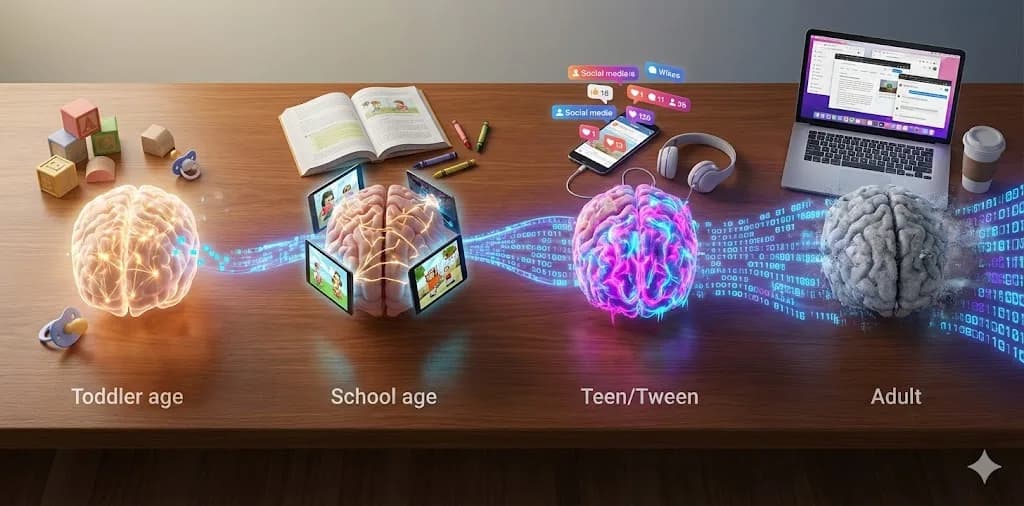
We choose content for young children and gradually teach older ones independence. An overview by age: what research shows and which boundaries I recommend setting before difficulties arise.

The pandemic ended. The feed did not.
When explaining children's turn towards screens today, I give more weight to changes in apps than to lockdown habits. What the endless stream of recommended videos changed, and why I support shared time without personal phones.
Further context
Articles on this topic
Phones at school: why I support an all-day ban and how to introduce it sensibly
The author's reflectionThe theory of points of contact with reality: sending children outside is not enough
Explanation / analysisA balanced approach to the digital future
GuideStrategies for parents
GuideThe role of schools and teachers
GuideBuilding digital resilience
Get straight to the point next time