Attention and habitsExplanation / analysis
Brainrot: when everything else is boring
Two hours of short videos, and then everything else is boring. Why I recommend limiting the endless feed and protecting parts of a child's day in advance, rather than only when difficulties arise.

Published · 11 min read · Updated
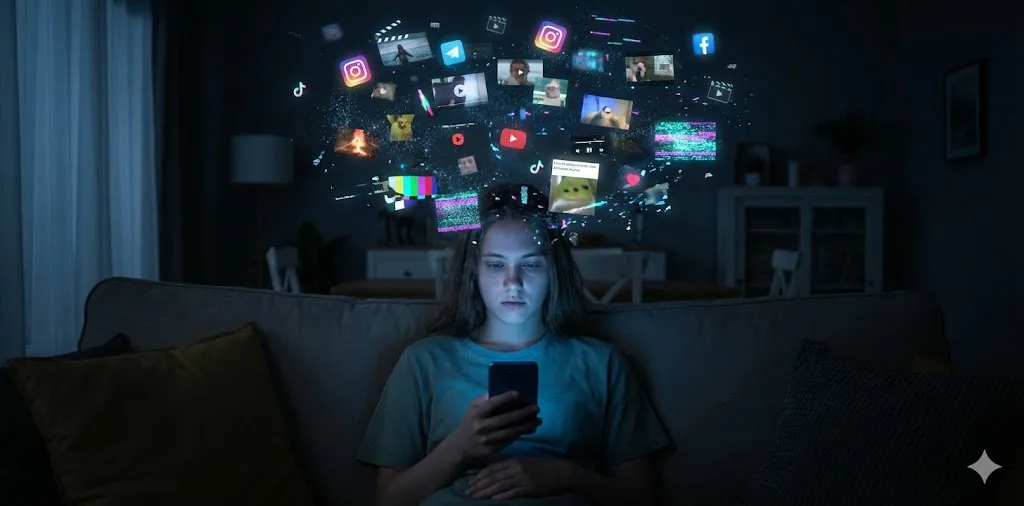
Imagine Lucka on the sofa. She has been watching short videos for two hours: dances, jokes, a failed jump into a swimming pool. She puts down her phone for a moment and asks her mum what they are going to do. Her mum suggests a book or a walk. ‘That's boring,’ Lucka replies, and lights up the screen again.
What concerns me most in that scene is the return to the phone. Lucka has had two hours of entertainment, yet once she puts it down, nothing else appeals to her. Perhaps she is not even enjoying the videos much any more. She just keeps waiting for the next one finally to be worth it.
What we mean by brainrot
Brainrot literally means ‘brain rot’. Oxford chose it as its word of the year in 2024: it refers to supposed mental dulling associated, among other things, with excessive consumption of trivial online content. It is an everyday expression, not a medical diagnosis. 1 In this series, we use it to describe long periods of largely unintentional viewing of rapidly changing content that is hard to leave. Someone meant to give their phone five minutes, and an hour later wonders where the evening went.
A short video in itself need not be a problem. A one-minute tutorial can solve something, a joke can make us smile, and watching something silly together can be fun. A child does not need to spend every spare minute learning. Rather than judging their taste, it is more useful to notice how the viewing happens: whether they choose the content, can stop and still have time for what they wanted to do. That is what makes sense to talk about with children. The insult ‘that's giving you brainrot’ will not help us much.
Entertainment without an ending
With a book, you reach the last page; with a television episode, the credits. A stream of short videos may offer no such ending. The next clip is already waiting, and continuing costs almost nothing. You have to decide to stop yourself.
The selection also adapts continually. TikTok itself explains that its recommendations take account of what you finish watching, skip, like or share. For most users, interactions including viewing time carry more weight than some other signals. 2 The app therefore receives feedback about what keeps you watching. The fact that you stayed with the videos does not, however, mean that spending your evening this way did you good.
The American Academy of Pediatrics points to a commercial environment that encourages platforms to prolong children's engagement through recommendations, infinite scrolling and rewards. 3 When we then tell a twelve-year-old to have more willpower, we leave aside the conditions in which they are making decisions. In the app, they need not know what they are looking for. They only have to open it and skip an uninteresting video. Homework, by contrast, asks them to start, spend a while not knowing what to do, and persist without an immediate reward. Parental consistency is one part of the problem; the other is an environment that makes it so easy for the child to keep watching.
Dopamine often enters the explanation. But its role is not simply to produce pleasure: it is also connected with motivation and learning. Wanting a reward and actually enjoying it are different processes. 4 We can notice this quite ordinarily while scrolling. Asked ‘Are you still enjoying this?’, we might already say no, yet we still want to see what comes next. This is one way to imagine Lucka from the opening. Another video is close at hand, while she does not feel like doing something else.
We do not even have to pick up the phone to be distracted. In a laboratory experiment by Cary Stothart and colleagues, incoming notifications reduced performance on an attention-demanding task even among participants who did not interact with the device. This does not mean that every notification prevents everyone from concentrating. It does show why simply asking someone not to reply to a message is insufficient. 9 I would remove unnecessary notifications during study. That does not remove the feed itself, though: once the app is open, the question remains of when the child will leave it.
What we know about attention and boredom
A 2025 meta-analysis combined the findings of 71 studies involving 98 299 participants. Greater use of short videos was associated with poorer results in cognitive functions, most strongly in attention and the ability to inhibit impulsive responses. The research included young people and adults. The association alone cannot establish how far viewing causes the difficulties, how far difficulties lead someone towards viewing, or what else affects both. 5 I take this as a reason to watch what happens in a child's ordinary day. Are they finding it harder to finish tasks? Do they repeatedly interrupt their reading? Do they want to stop in the evening but fail to do so? Such changes deserve attention. However, I recommend setting basic limits on use even for children in whom we do not yet observe anything similar.
Something surprising can also happen with boredom. In seven experiments involving a total of 1 223 participants, switching between or within videos led to more boredom and less engagement than uninterrupted viewing. Results were less clear outside university samples and when working with text. The experiments captured a short-term experience, not permanent changes to children's brains. Even so, they show that searching for a more entertaining clip can leave someone more bored than before. 6 Lucka may therefore fail to find the rest or satisfaction she expects in further videos.
When does a child practise concentrating?
A child's brain develops through the interplay of biological development and experience. Neural connections form, strengthen and are pruned, and repeated interactions with the environment matter. 7 This raises a practical question for parents and teachers: where does the child have a chance to practise what we ask of them? A more complex task requires uninterrupted time. Independent play needs a period we do not fill with a ready-made programme. And if we expect them to join a conversation, it is worth looking at the screens around the shared table too. These are conditions we can change at home and in the classroom.
When a child sleeps through the afternoon after a night of videos, we have a specific reason to adjust the evening routine. We do not have to wait for a scan of their brain. Similarly, we can protect time for reading, play and eating together even if we and the child disagree about what counts as brainrot.
Fourteen hours a week
Two hours of scrolling a day adds up to fourteen hours a week. This is a simple calculation, not a figure for the average child. At that volume, it is worth addressing the place the feed has in their day. Checking whether individual videos are harmful is not enough. We should also ask whether the child wanted to spend their time this way, and what no longer fitted into it.
Look together at time spent in apps, and ask about specific evenings: what ran on, what remained unfinished and how the child felt after putting the phone away. A conversation about videos repeatedly postponing bedtime is different from an argument about whether a parent likes their favourite clips. It might begin like this:
‘I've noticed that lately you're getting to bed later because of videos. I don't want to discuss every clip. I want us to work out how to finish the evening so you're not exhausted in the morning.’
What to change at home and at school
I do not recommend giving children unrestricted access to a personalised stream of short videos. For young children, I would not introduce free access to the feed at all. With age, I would extend independence and explanations, while preserving parts of the day the feed does not enter. A parent does not first have to document worse grades or a sleep problem before setting a boundary.
At home, I would start by protecting study, sleep and shared meals. During homework, a personal phone should be put away; during sleep, it should be out of reach and free of unnecessary notifications. If a health-related or other essential need requires an exception, address it specifically. If the task requires a computer, prepare the necessary tools without simultaneous personal messages or an entertainment feed. We adults should put our phones away at meals too.
Watching habits together still makes sense. It helps reveal where a rule meets resistance, when videos run on and what the child is actually looking for on their phone. But it is not a waiting period during which we must leave everything without limits. Explain what you want to protect, hear the objections and involve the child in shaping an age-appropriate agreement. The child's disagreement does not in itself mean that a rule cannot apply. Nor do you need to read their private messages in order to establish rules.
Pay attention, too, to what you offer the child instead of the phone. An outing chosen to suit a parent's taste may be no more appealing than before. Ask about something they wanted to do but never got round to. Sometimes it is enough to prepare painting materials, arrange to meet a friend or start making something together. Feel free to leave some leisure time without a programme. A child does not have to pay for putting down their phone with another organised activity.
At school, I support a ban on personal phone use throughout the school day, including breaks. With health-related and essential support exceptions settled beforehand, as well as a way for a parent to contact their child in an emergency. I want school to provide space for uninterrupted work and shared time, rather than every teacher having to negotiate about the same phone again. The school should explain clearly to children, parents and staff how phones are put away and how the rules work.
I would, by contrast, develop teaching about technology. For work with digital tools and AI, I recommend school devices in a prepared environment without distracting notifications, a suitably chosen tool and a teacher's guidance. We need to know what the pupil is learning and which part of the work they should manage independently. A school tablet alone does not decide that.
These are my recommendations for the conditions of upbringing and education. The American Academy of Pediatrics also recommends a family plan, shared boundaries and screen-free spaces. 3
It is worth trying
In a Danish randomised study involving 89 families and 181 children, two weeks of substantially reduced recreational screen use led to improvements in psychological and behavioural difficulties rated by parents compared with the control group. Families handed over smartphones and tablets and aimed for no more than three hours of recreational screen use per person per week. This was therefore quite an intensive intervention. The finding cannot be taken as a recommendation of the same limit for every family or as a guarantee of a long-term effect. 8
A school restriction is not the same as a restriction across the whole family. The 2025 SMART Schools study compared 1 227 pupils from 30 English schools. Stricter rules were associated with less phone use at school, but not with better mental wellbeing or lower overall use. This was an observational comparison, not a randomly allocated ban. 10 That is why I recommend a school ban as a rule for the school day, not as a promise that it will solve children's mental health on its own.
With Lucka, then, alongside the conversation, I would clearly determine when the videos are put away. Access to the feed would stop being a given throughout the entire day. I would then watch what the freed-up time enabled her to do: whether she returned to playing, kept an agreed plan or no longer had to catch up with everything else in the evening. That result interests me more than an argument over the label brainrot.
Sources and supporting material
- Oxford University Press (2024): Brain rot, word of the year. Evidence for the meaning of the expression, not a medical diagnosis. Oxford University Press.
- TikTok: How content recommendations work. The platform's description of its own system; not an independent assessment of health effects. TikTok Support.
- American Academy of Pediatrics (2026): Helping Kids Thrive in a Digital World. An explanation of AAP policy for families: the commercial environment, family rules and screen-free spaces. HealthyChildren.org.
- Berridge, K. C.; Kringelbach, M. L. (2015): Pleasure systems in the brain. A review of reward neuroscience, distinguishing motivation from the experience of pleasure. Neuron. DOI: 10.1016/j.neuron.2015.02.018.
- Nguyen, L. et al. (2025): Feeds, feelings, and focus. Psychological Bulletin, 151(9), 1125–1146. A meta-analysis of associations between short-video use, cognitive functions and mental health. DOI: 10.1037/bul0000498. Bibliographic record and abstract.
- Tam, K. Y. Y.; Inzlicht, M. (2024): Fast-forward to boredom. Journal of Experimental Psychology: General, 153(10), 2409–2426. Experiments on switching digital content. DOI: 10.1037/xge0001639.
- Center on the Developing Child, Harvard University: Brain Architecture. General findings on brain development and the role of experience. Harvard University.
- Schmidt-Persson, J. et al. (2024): Screen Media Use and Mental Health of Children and Adolescents. JAMA Network Open, 7(7), e2419881. A pre-planned secondary analysis of a family randomised study. DOI: 10.1001/jamanetworkopen.2024.19881.
- Stothart, C.; Mitchum, A.; Yehnert, C. (2015): The attentional cost of receiving a cell phone notification. Journal of Experimental Psychology: Human Perception and Performance, 41(4), 893–897. A laboratory attention task; this is not a study of the effectiveness of a school ban. DOI: 10.1037/xhp0000100.
- Goodyear, V. A. et al. (2025): School phone policies and their association with mental wellbeing, phone use, and social media use (SMART Schools). The Lancet Regional Health – Europe, 51, 101211. A cross-sectional observational comparison of 30 schools, not an experiment. DOI: 10.1016/j.lanepe.2025.101211.
The practical steps in the text are the author's recommendations. They are not a diagnostic test or a promise of a particular effect for every child.
One recommended next step
Continue with part 2 z 7Brainrot by age: what to watch for in young children, schoolchildren and teenagersOpen article →