The conversation has shifted to access to the phone. We do not yet know more about the original need. Refusing to show the whole chat does not itself establish danger.
Parents and schools a conversation first, not a phone inspection
Using the result in life
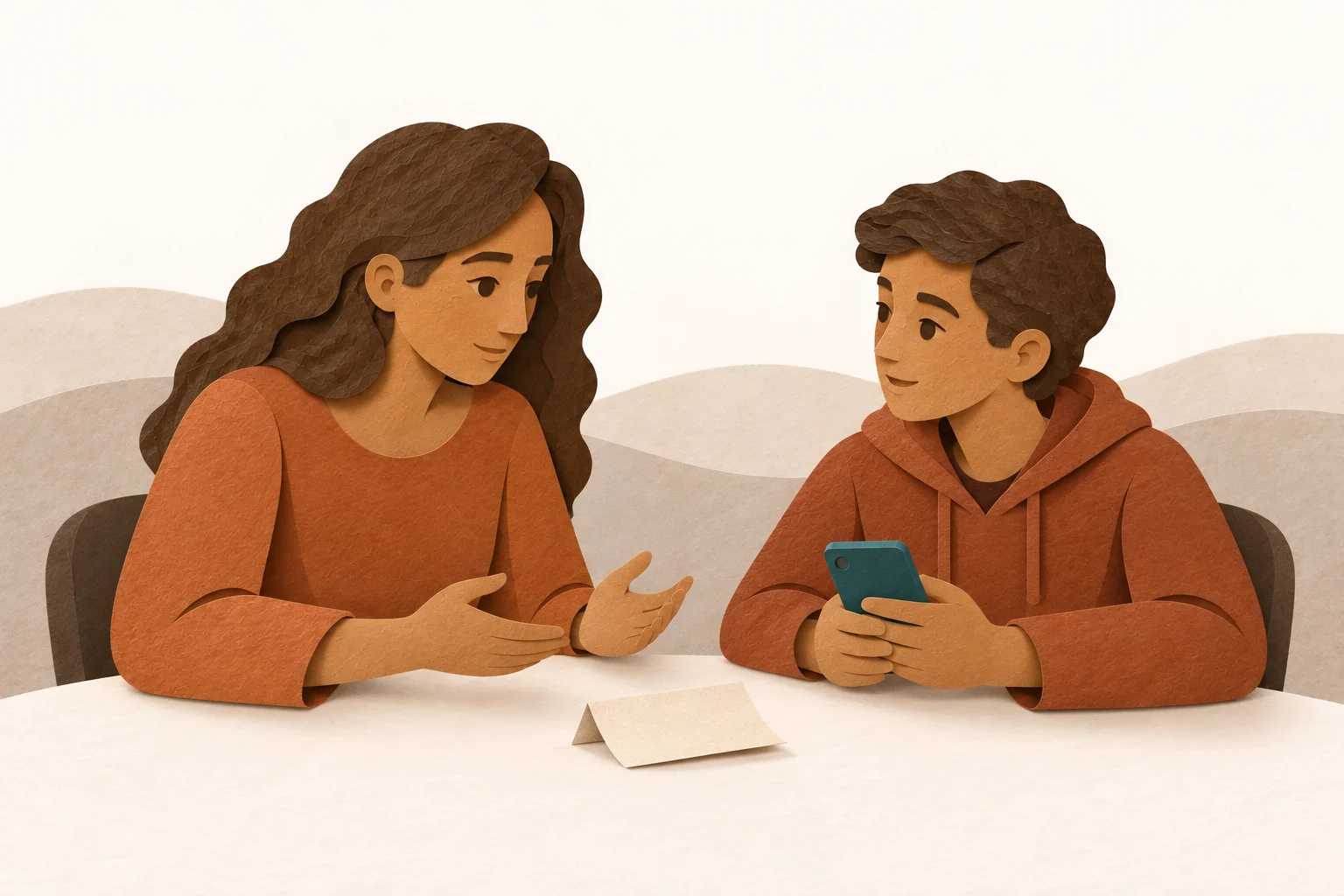
One sentence from two sides
A child says: ‘It’s easier to talk about this with AI.’ An adult may hear something different from what the child needs to communicate.
An example situation with two possible continuations. Not a prediction of a particular child’s response.
What the adult may hear
‘They don’t need us any more.’
What else might be behind it
‘I don’t want to be afraid someone will laugh at me.’
A possibility we need to explore through conversation. Not an explanation we already know.How will you open the conversation?
An offer of a specific time and way of talking emerges. The adult must also keep it. One well-chosen sentence does not guarantee trust.
The question is not only ‘What is AI doing to the child?’ It is also ‘What happens when a child tries to tell us something?’
On this page
A teenager need not say ‘I use a mental health tool’. They may simply open a chat in the evening because they feel sad or do not want to confide again. In a US survey of 1,009 people aged 12–21, after statistical weighting, 19.2% reported experience of a chatbot for mental health advice. Among these users, 63.3% had told no one about their use and 91.7% rated the advice at least somewhat useful. The data are from November 2025, not a Czech estimate or a measure of treatment effect.[1]
The official Czech summary of Czech Pupils in the Online World 2025 states that 14% of respondents found it easier to confide in AI than in a person. The main analyses used 42,772 respondents aged 13–17, with data collected in spring 2025.[2] ‘Easier’ tells us about the ease of confiding. It does not say how many friends they have, whom they send more messages to or whom they prefer.
For a particular child, it therefore matters to find out what the conversation makes possible. It may be asking a question without fear of ridicule, sharing a sensitive subject or first finding words. Having adults around does not yet tell us how easily they confide in them. Let us also attend to our reaction when they try.
Begin with a conversation, not a phone inspection
‘Do you ever use AI when you need to discuss something?’ opens a conversation differently from ‘aren’t you addicted to it?’ Ask what is pleasant, what is unpleasant and whether there was advice the child did not understand. They need not present the whole private chat for this. Nor does ‘I know it’s a robot’ yet explain what they do with the response.
If they do not want to burden you, offer real time: ‘I’m finishing something now. We’ll sit down in half an hour. If it can’t wait or you’re afraid for yourself, tell me straight away.’ Also say whom they can approach when you are unavailable or it is not safe to begin with you. When you require a change in use, connect the boundary with an offer of contact, shared activity and further help. Not as a reward for handing over the phone.
When concerned, describe observed changes: ‘You’re very tired in the mornings, and school is harder. We need to find out what is happening with your sleep.’ Affection or privacy alone are not an explanation. Bullying, illness or a situation at home may also cause the difficulties. The chatbot may be part of the problem, an attempt to cope with it, or both.
Restricting a particular unsuitable service, payments or night-time use may be necessary. A ban is neither the automatic first reaction nor an option ruled out in advance. For younger children, we recommend shared, bounded use for a specific activity, rather than a private, constantly available confidant. The adult instructions in this book are not a brief for an entire class or a way around age rules.
Protecting a child comes before a lesson about AI
Once a child describes violence, abuse or serious danger, the main task is not assessing the chatbot’s quality. According to Czech guidance, it matters to listen sensitively, not investigate the child, not promise absolute secrecy, and follow an appropriate safeguarding procedure.[3]
‘I’m glad you told me. I need to find out now how to keep you safe. I will have to discuss some things with people who can help us. I’ll tell you what happens next.’
A child need not repeat intimate details to every adult before receiving further help. If a parent or caregiver is suspected of harming them, do not automatically pass on the entire disclosure or confront that person. Consult the appropriate professionals and authorities on the procedure. The school should know in advance who receives a concern and how the school counselling team, leadership, OSPOD (the Czech child protection authority) or police follow it up. This is not a compulsory waiting list; immediate help must not wait for an internal meeting.[3:1]
Do not enter a pupil’s intimate conversations or health data into an ordinary personal AI account to decide what to do. The record should distinguish observations, disclosures and uncertainties. A label generated from a transcript is no substitute for a procedure.
How to ask about use in professional work
A client may bring a good question from AI or dangerous advice. They may have a relationship with the system or use it entirely technically. Ask what helped, what confused them and how responses affected their decisions. You do not need a whole export or agreement on AI’s nature to begin working together. A helpful question might be: ‘What did you manage to say or understand there that was difficult elsewhere?’ Alongside the errors, the need that led the person to seek contact remains visible.
When reading a transcript together, agree on the purpose and scope. You can trace what the assistant added, but cannot independently verify every event described. A useful contribution can remain useful. With faulty advice, attend to its conclusion and consequences; merely reminding someone that AI is not a person does not explain them.
Your own professional use also requires an approved procedure for the particular tool, purpose and data. Without it, work with fictional situations. Renaming a client is not, by itself, anonymisation.
Parents and other adults acting in a child’s interests in the Czech Republic can use Rodičovská linka (the parents’ helpline), 606 021 021. Its telephone service is neither free nor round the clock: Monday to Thursday 9 a.m.–9 p.m., Friday 9 a.m.–5 p.m., Czech local time, with call charges according to your plan.[4] In immediate danger, do not wait for the counselling service to open.
Sources and notes for this chapter
McBain, R. K., Cantor, J. H., Breslau, J. et al. AI Chatbot Use and Disclosure for Mental Health Among US Adolescents and Young Adults. JAMA Pediatrics, online 1 June 2026; 180(8):884–890. Article. Methods and results reviewed 12 September 2026. A weighted US survey, not Czech prevalence or a measure of treatment effect; usefulness was respondents’ own assessment. ↩︎
Palacký University Olomouc. Some Children Confide in AI More Than People, New Research Shows. 2 June 2026. zurnal.upol.cz. Official summary of Czech Pupils in the Online World 2025, loaded 12 September 2026. The main analyses include 42,772 respondents aged 13–17, with data collected in April and May 2025. According to the summary, the 14% figure concerns finding it easier to confide in AI, not sending more messages or preferring it to people. The original tables were not rechecked during this editorial review. ↩︎
Blažková, K., Petrenko, R. et al. The Abused, Sexually Abused and Neglected Child at School: Recommended Procedures for School Staff. Czech Ministry of Education, 2024, reference MŠMT-3262/2024-1. Official guidance page; PDF. The text and relevant document pages were verified. This guide does not replace the guidance or a legal assessment of a particular case. ↩︎ ↩︎
Rodičovská linka (Czech parents’ helpline). Help and the overview of the Czech Association of Helpline Workers. Opening hours, calls at ordinary rates. Reviewed 12 September 2026. Telephone 606 021 021 is not a free round-the-clock line. ↩︎