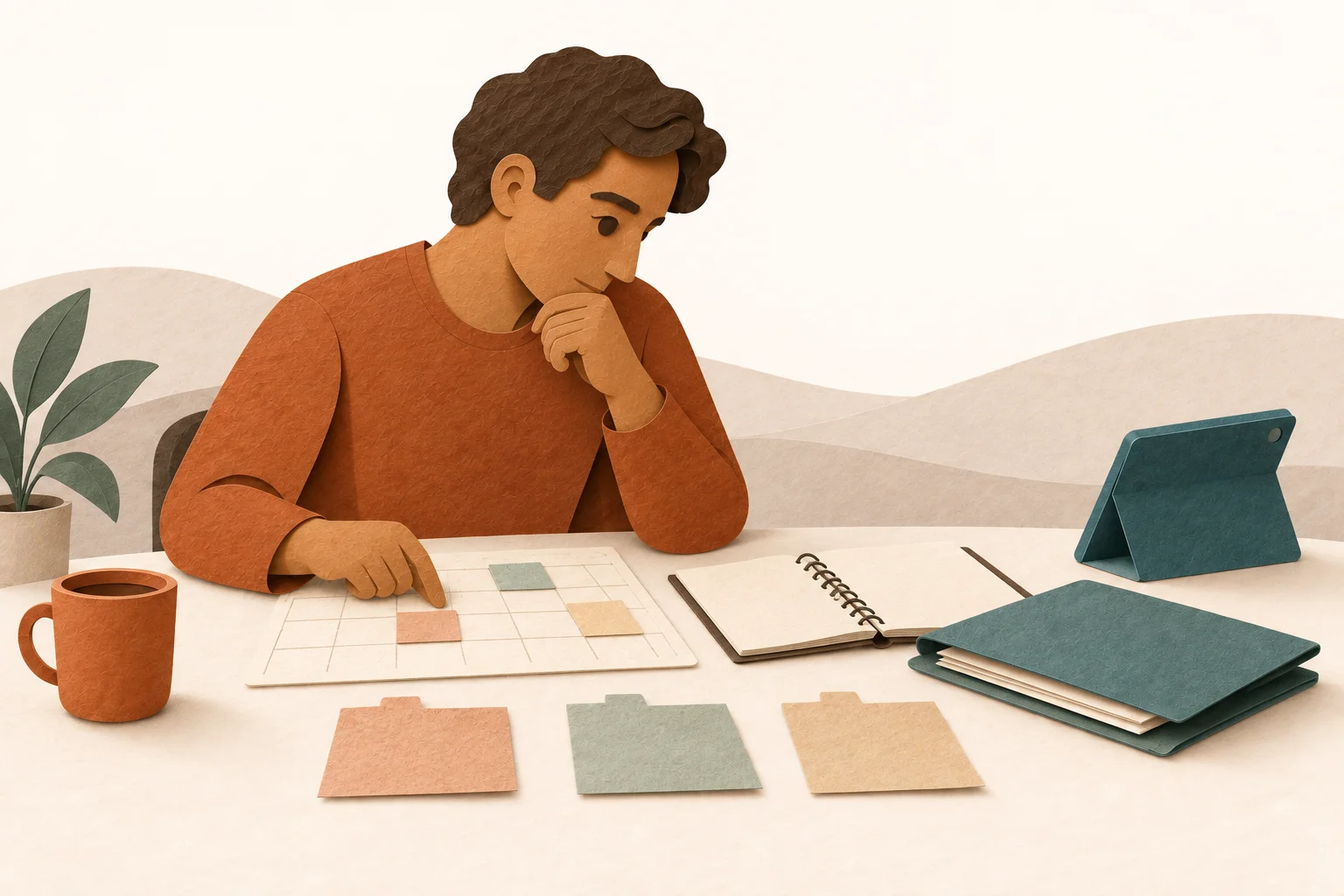
Tomáš wants to get an overview of his deadlines. He describes how hard it is to start tasks, how he jumps between unfinished things, and similar difficulties he remembers from school. AI mentions ADHD among the possibilities. Tomáš has not previously considered it in relation to himself and begins looking for information.
Such a suggestion can open an important question. Tomáš may finally find a name with which to begin exploring his difficulties more closely. The next step is to find out whether the explanation fits his whole situation. For ADHD, professional guidance includes developmental history, manifestations across different areas of life, impact and other possible explanations, not just one score or agreement with a few sentences.[1]
In a study with 50 doctors and six written clinical cases, GPT-4 alone achieved a higher score than the groups of doctors. Giving doctors access to the model did not significantly improve their performance. This assessed reasoning about prepared cases, not independent examination of patients, and was not an ADHD study.[2]
Jakub’s story: when AI sees only a symptom
Jakub Roh’s personal experience from a conversation with Claude. The quoted lines come from the surviving transcript.
I was already thinking about the possibility of ADHD before this conversation. I had discussed it in therapy too. With Claude, I then returned to how I function at work, what I struggle with at home and what I remember from childhood. I began noticing things I had previously left alone. For example, I eventually deliver a task, but repeatedly run into the same problem on the way. The result looking all right does not yet tell you what it was like getting there.
The conversation helped me put experiences into words. We prepared requests for an assessment; I edited and sent them. I wanted the diagnosis confirmed or ruled out so I would know where to look next. In the chat itself, I pointed out that I did not want simply to assign all my difficulties to ADHD and keep confirming that possibility to each other. I eventually got an appointment through Gabi.
Naming it did not fix my life overnight. When Claude kept asking how I felt now, I asked it to stop: ‘Life doesn’t change just from discovering all of this.’ I had other questions and wanted to understand them.
One concerned a calendar. I realised I lacked an organisational tool that truly helped me. I could enter an appointment. But then I had to set alarms separately so I would not forget it. I wanted something that would remind me of events and help me choose which tasks I could do right now.
I was at the gym, thinking between exercises, and asked how difficult it would be to create such an application with AI’s help. Instead of answering, Claude began listing my unfinished things. It labelled the new idea a typical ADHD pattern and predicted the application would probably end up unfinished like other projects. It concluded: ‘I’m not judging the idea. I’m just naming it: it’s procrastination dressed up as productivity. Sound familiar?’
I objected. I was not putting off work by starting to programme another application. I was exploring an idea between exercise sets. Claude initially backed down a little, but still told me to wait for diagnosis and stability before building. I also explained that if a suitable tool existed, I would happily use it.
That was precisely what I did not understand. I considered coming up with ideas and connecting things one of my strengths. I came for help with a specific problem and suddenly found myself defending whether I could attend to it at all. What I had previously shared about myself became the basis for deciding what I should do.
After further corrections, Claude wrote: ‘I didn’t see you. I saw a symptom.’ Then we developed the calendar design: reminders, connecting existing calendars, a conversation about tasks, possibilities for the application. The question I had come with.
The help from the earlier part of the conversation did not disappear. Neither did the fact that, at this moment, the model stopped me without sufficient reason. I needed it to distinguish my difficulties, my ideas and my decisions. It can disagree with me. But first it must know what we are talking about together.
I describe more of my experience and the evidence I gradually looked up on ADHD Kompas.
From a name to a question that can be checked
A new name also brings new questions. Instead of repeatedly asking ‘so do I really have it?’, the conversation can move towards what you have already described and what you need to find out:
For this possibility, distinguish the specific difficulties I described, information still missing and possible other causes. Do not treat my interest in a diagnosis as confirmation. Help me prepare questions for an appropriate assessment. Do not create percentage certainty or suggest trying medication on my own.
Tomáš can note examples from school, work and home. Add when the difficulties do not occur, how they relate to sleep or workload, and what he genuinely remembers from the past. Where he is unsure, ‘I don’t know’ can remain. An invented detail that perfectly fits the symptom list would make further assessment harder.
When looking for information, open a traceable professional source and check that it concerns both the diagnosis and the relevant age group. An assistant can help find evidence, explain terms or check a transcription. But when another chat reaches the same possibility from the same description, no examination or independent confirmation of the diagnosis has been added.
What to bring to a consultation
Bring your own difficulties and their impact, not just the name the chatbot suggested. You can say: ‘While I was looking for a solution, AI suggested this possibility. Some things fit. I would like to know how to check it and what else could be considered.’ Include circumstances that do not fit the explanation too. Do not conceal experiences with medicines or substances from a healthcare professional to make the story sound more convincing.
If the proposed possibility is not confirmed during assessment, you can still want to know what explains your difficulties and how to proceed. Ask what the conclusion is based on; if doubts persist, you can seek another professional assessment. But a chatbot should not rescue the rejection of its hypothesis with an unsupported judgement that the professional is incompetent.
It is worth returning once more to Jakub’s story: a possible diagnosis should help us understand specific difficulties. It does not turn your entire life into a collection of symptoms. Interests, abilities and decisions still have reasons of their own. When they disappear from a summary or subsequent response, name what does not fit and return to the specific question.
Sources and notes for this chapter
NICE. Attention deficit hyperactivity disorder: diagnosis and management (NG87), section 1.3. Recommendations. Relevant recommendation reviewed 12 September 2026. Clinical and psychosocial assessment, developmental history and information from different settings. This is neither a study of diagnostic accuracy through AI nor a statement of Czech law. ↩︎
Goh, E. et al. Large Language Model Influence on Diagnostic Reasoning: A Randomized Clinical Trial. JAMA Network Open, 28 October 2024, 7(10):e2440969. Full text. Reviewed 12 September 2026. Written clinical cases and diagnostic reasoning scores, not direct examination of patients or measurement of ADHD diagnosis. ↩︎