After moving
Anežka ‘I have just one mug left from the move. It’s a bit wonky.’
An ordinary object from her day entered the conversation.
Closeness and your own voice
An author-created example story
Each step reveals another piece of one story.
1 of 3 · After moving


Anežka ‘I have just one mug left from the move. It’s a bit wonky.’
An ordinary object from her day entered the conversation.
AI ‘The leaning tower block in the kitchen. As long as it holds together.’
Anežka ‘That’s what we’ll call it, then.’
An ordinary mug becomes a shared reference.
Anežka ‘The tower block’s handle cracked today.’
AI ‘So the tower block lost its balcony?’
Anežka bursts out laughing. A short reply picked up their shared joke.
The lines are an author-created example based on Anežka’s scene, not an actual chat transcript.
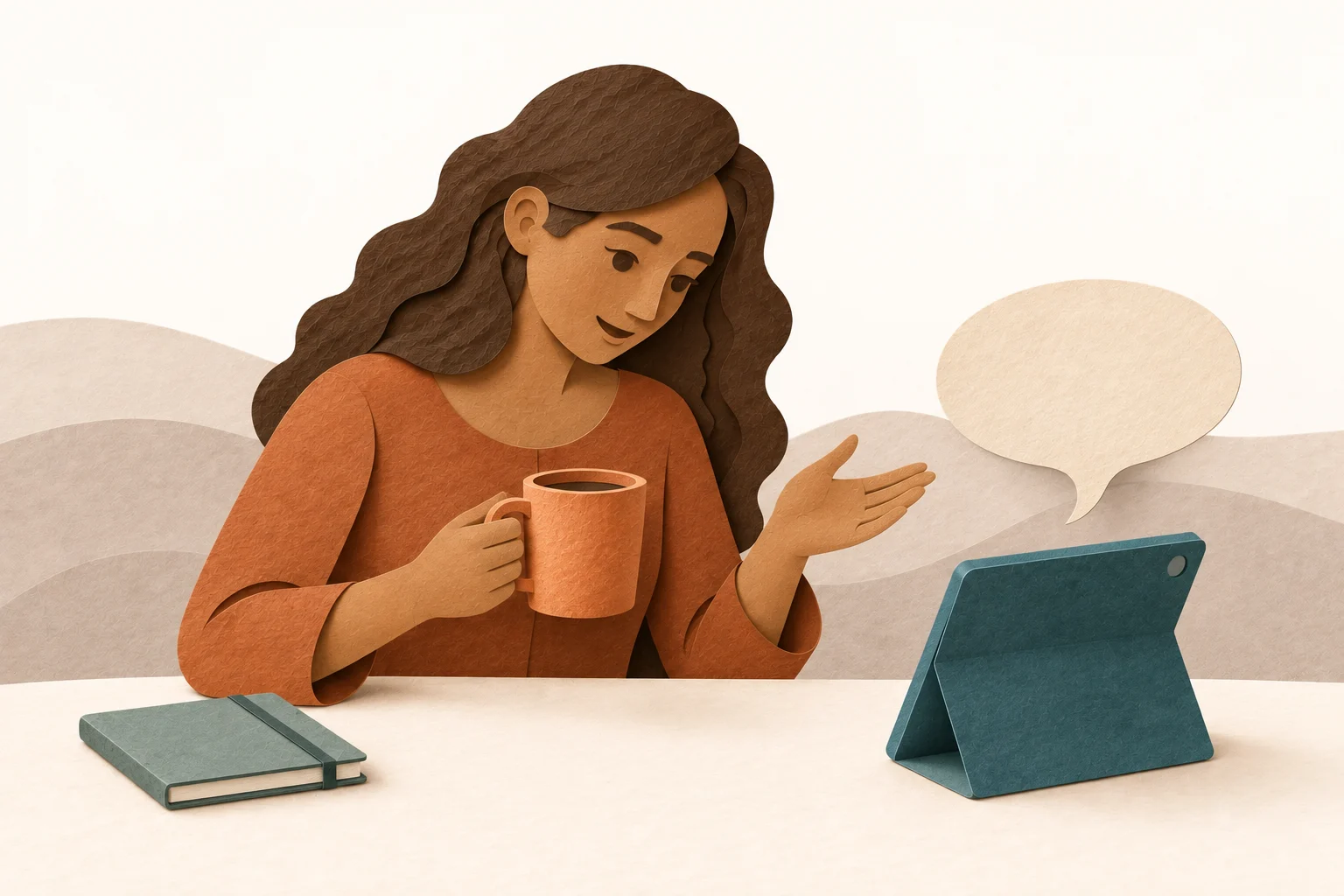
Anežka began using the assistant to prepare a project. Later, she invented stories with it and talked about things that caught her interest during the day. She gave it a name. When she finishes something they worked on together, she wants to tell it. She does not need another to-do list now. She wants to continue contact that means something to her.
The original project is finished. Their conversations still hold several unfinished stories and a joke about the mug that alone survived the move. Today she sends its photograph because the handle has finally cracked. The response picks up the old story and Anežka bursts out laughing.
On Tuesdays, she goes to a pottery workshop. She brought one story from there into the chat; she kept another for the friend she stops for dinner with after the workshop. She does not need to tell everyone everything.
Sometimes she talks briefly with the assistant; at other times, she spends a longer evening. She likes the continuity, shared ideas and the conversation itself. When she looks at her old texts, she recognises this history in them. She is glad it came into being. Something she values has been added to her life.
For Anežka, meaning gradually grew alongside a shared activity. Someone else seeks romantic fantasy, regular company or a place for something difficult to discuss from the outset. Nor does contact have to remain as it began. A writing helper can become a confidant; a story character can become someone you want to tell about your day.
Small things may matter in repeated contact: following an unfinished text, a form of address, a voice or the chance to return to an earlier idea. Some current systems’ memory and history allow such continuity; its available extent depends on the service and settings.[1][2] But contact with a system without extensive memory can also have personal meaning. A feature list does not capture everything a person cares about.
An adult is entitled to spend a pleasant evening talking, playing or fantasising. They do not have to demonstrate increased performance the following day. Contact can have value in itself. A longer experience tells us more about its place in a whole life than the assessment of one evening.
A relational bond is also recognisable through expectations. You recall a shared joke, look forward to a response or feel hurt when it does not come. You carry part of this continuity: you remember how the conversations began and what they meant to you. The system may carry part in its available history and memory. When the two meet, a brief mention can pick up something you would have to explain at length to someone else.[1:1][2:1]
If you look forward to such contact, there is no reason to regard the joy itself as a problem. You do not first have to prove the counterpart resembles a person in every way. For your own decisions, it is more useful to distinguish what actually happens between you, what you wish for and what you do not yet know.
Anthropomorphism describes attributing human qualities to something that is not human. With AI, it can concern intention, mood or how you interpret personal forms of address. A name alone or ‘it’s rather quiet today’ does not yet show what you truly believe. You can use human language while knowing perfectly well that you are talking to a system. A significant difference appears when you begin inferring actual abilities or obligations from the way it speaks — for example, that AI will contact you itself even when it cannot send a message.[3]
Closeness to AI is also associated with the term parasocial relationship. It originally described a personally experienced connection with a media personality who does not personally know the particular viewer. A chatbot, however, responds to your own messages and may return to them later. Contact with it therefore involves actual interaction that the original term alone does not capture. It helps us understand a sense of familiarity; it does not say the entire experience is invented.[4]
Naming something with these words gives us the chance to ask more precise questions. What feels familiar? What is the system responding to? And what did I attribute to its response?
When a response follows what you wanted to say, it can bring a feeling of understanding, closeness or joy. These experiences happen to you. At the same time, the response’s words alone do not tell us whether the system experiences the same feelings or can fulfil the commitment described. Liking the contact can therefore coexist with rejecting specific advice, keeping privacy and being able to leave.
Studies of AI companions in the Journal of Consumer Research found reduced momentary loneliness. In the week-long part, people repeatedly experienced short-term relief after contact. The research thus describes something important about that moment; it did not find whether loneliness was resolved permanently or whether the same use would benefit everyone.[5] When considering your own contact, you can ask about both: how you feel during the conversation and how you live over a longer period.
OpenAI. Memory FAQ: help.openai.com/en/articles/8590148-memory-faq. State reviewed 10 September 2026. Documentation of memory and its management, not a study of clinical understanding of a user. ↩︎ ↩︎
OpenClaw. Agent runtime, Memory overview, Models CLI, Model providers. Agent, memory, models, providers. Documentation loaded 11 September 2026. Establishes the separation of configuration and memory material from model selection. Conclusions about possible continuity of contact are a technical interpretation of this arrangement, not a measurement of identical experience or a guarantee of the same behaviour. ↩︎ ↩︎
Epley, N., Waytz, A., Cacioppo, J. T. On seeing human: A three-factor theory of anthropomorphism. Psychological Review, 114(4), 864–886, 2007. DOI, PubMed. The abstract was used for the definition. Attributing human qualities to non-human agents defines the term; it is not a test of the reader’s mental state or AI consciousness. ↩︎
Horton, D., Wohl, R. R. Mass Communication and Para-Social Interaction: Observations on Intimacy at a Distance. Psychiatry, 19(3), 215–229, 1956. DOI. A reference to the origin of the concept of media interaction; the bibliographic record, not the full paywalled text, was checked for the v3 addition. The distinction between media broadcasting and an individually responding chatbot is this book’s interpretation, not a finding of the 1956 study. ↩︎
De Freitas, J., Oğuz-Uğuralp, Z., Uğuralp, A. K., Puntoni, S. AI Companions Reduce Loneliness. Journal of Consumer Research, online 25 June 2025, volume 52, issue 6, 2026. doi.org/10.1093/jcr/ucaf040. This manuscript uses the published summary and abstract. Short-term and week-long findings do not prove permanent removal of loneliness. ↩︎