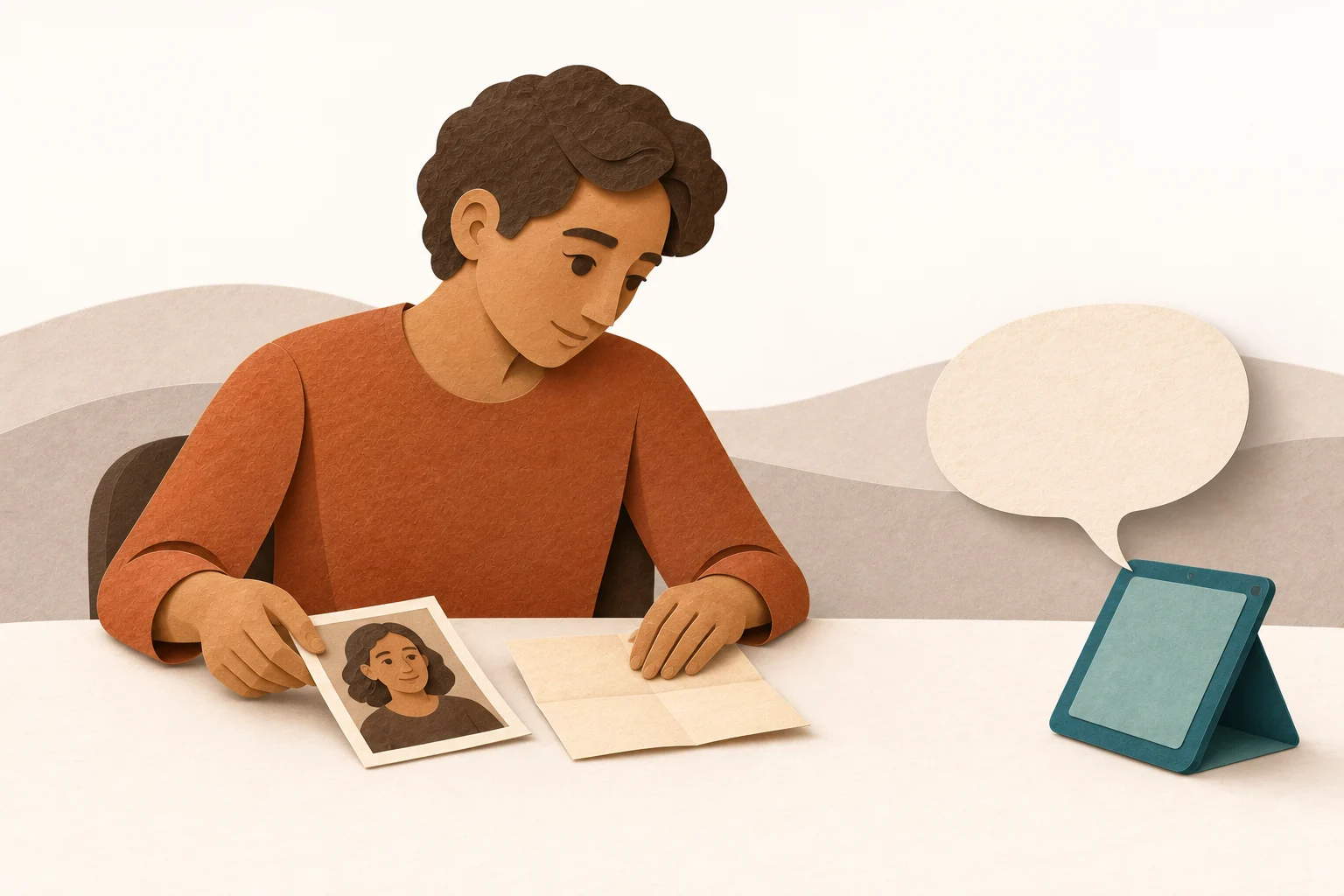
In a loved one’s last voice message, you hear a sentence they actually said. In a generated imitation, you may hear a sentence they never spoke. This difference is the foundation of decisions about services offering a ‘digital return’.
An archive, a recording and a generated response
A photograph, letter or original recording captures something a person actually created. An interactive interface can find their recorded answer. A generative imitation, by contrast, also creates new sentences. Similarity of style or voice does not make them the actual expression of the person portrayed.
In an example situation, a bereaved woman hears in her father’s voice that he forgives her for an old conflict. It may affect her deeply. But if the system created the sentence, it is not a newly discovered record of her father’s decision. The response establishes nothing about what he thought.
Likewise, new instructions about inheritance, family relationships or treatment cannot be derived from an imitation. The practical problem is not only a possible factual error. It also concerns whom we attribute authorship and authority to.
Who consents to such an encounter
The wish to hear a familiar voice once more is understandable. Before encountering its imitation, you need to know whether you will hear an actual recording or newly created words. The decision whether to enter such contact also belongs to you.
Hollanek and Nowaczyk-Basińska’s 2024 ethical analysis distinguishes the people whose data are used, holders of those data and people communicating with the simulation. It recommends transparency, consent and the possibility of sensitive closure. This is ethical work with example scenarios, not clinical verification of whether simulations treat or worsen grief.
An archive of real memories, searching original recordings and talking to a generating imitation are different experiences. We cannot consider their effects identical; we do not recommend a digital imitation here as treatment for loss. Before creating one, clarify what will be preserved, who may use it and whether the recipient wants such contact.
Do not give a simulation of someone who died as an unexpected gift. Being able to decline contact matters as much as being able to initiate it. For a child, we would not offer a generating imitation of a parent as their continuing authority or as a preventive or therapeutic aid.
Living people have boundaries too
A digital version of a former partner or classmate raises another question of consent. The real person can refuse contact while the created character responds to the user’s instructions. Its willingness says nothing about the actual person’s wishes.
It is inappropriate to use an imitation to ‘train’ how to break through their refusal or to obtain supposed information about their feelings. Respect for a human boundary does not disappear because a differently responding digital version can be created.
Someone who does not use AI can be affected too
A fake intimate photograph, forged voice message or invented conversation can affect a real person’s reputation and safety. In such a situation, do not begin by debating whether the picture is ‘only artificial’.
Help the affected person find support and use the service’s reporting process. Record, for example, the post address, account and time. Do not unnecessarily send the material to more people. For sexual content depicting a child, do not request further copies or distribute it as evidence around the school; consult an appropriate specialist service or police on the procedure. Image-based abuse guidance also includes material created or edited with AI.
In blackmail or immediate danger, do not wait for an automated analysis. Help contacts also apply to a situation that began digitally.
Sources and notes for this chapter